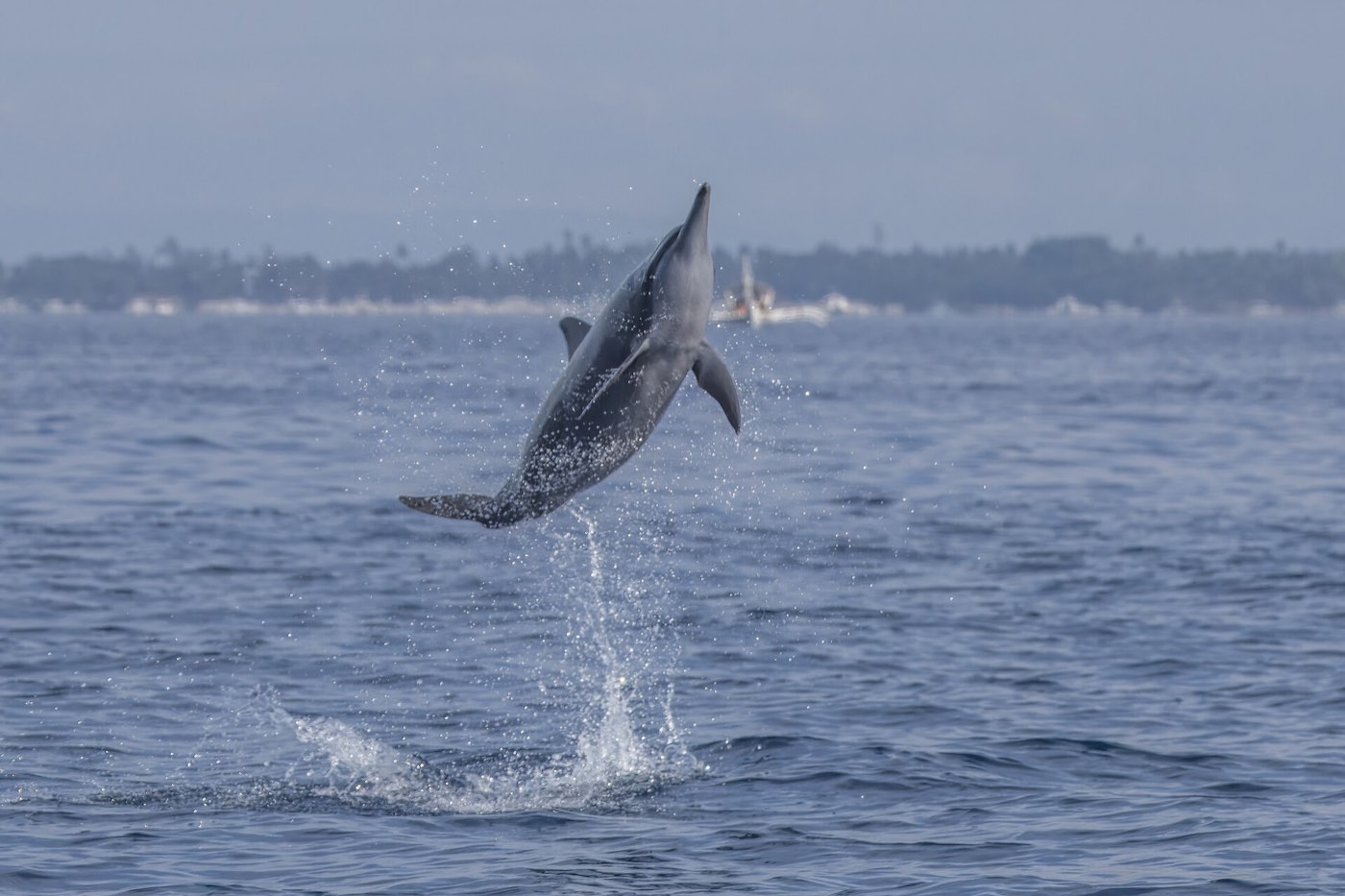
Dolphin watching in Puerto Princesa Bay
You are buying a boat ride with a good chance of dolphins, not a dolphin encounter. Trips run 06:30 to 10:30 in Puerto Princesa Bay for about ₱2,000 (~$34), with a range of ₱1,500–2,500 across agencies. The species is the spinner dolphin, the season is April to October, and there is no sighting guarantee — trips are cancelled outright if the seas are bad or too few people join. It has also effectively vanished from the big booking platforms: zero GetYourGuide and Klook listings. Which is the answer to whether you can book it online. You cannot. Arrange it in the city.
Nobody can sell you a dolphin
Every operator here works to international watching guidelines, which means no feeding, no chasing and no promises. Take that at face value before you pay.
The boats go out at 06:30 and are back by 10:30, working Puerto Princesa Bay for pods of spinner dolphins. Some mornings you get a long encounter with animals riding the bow; some mornings you get four hours on the water and a story about the day before. Operators are explicit that sightings are not guaranteed, and they cancel the trip when the seas are bad or when too few people join to fill a boat — so a solo booking in low season may simply not run.
Price is ₱2,000 per person as the standard quote, with ₱1,500–2,500 across different agencies. The operators are small and local: Dolphin and Whales Travel & Tours and Tour Z Palawan are the names that come up. This is not a mass product with a fleet, and the pricing spread reflects who owns the boat rather than what you get.
Set the expectation the way the whale shark trips here are set: this coast does natural, unfed, unbaited encounters, which is ethically much better than the alternative on offer elsewhere in the Philippines and commercially much less reliable. Both of those things are true at once and you should book knowing it.
Zero listings on GetYourGuide and Klook — and that is the answer
If you have been searching and finding nothing, you have not searched badly. There is nothing to find.
Dolphin watching used to appear in Puerto Princesa's tour inventory and has effectively disappeared from the big platforms. There are no GetYourGuide listings and no Klook listings for it in this city — against, for scale, 4,147 Klook reviews on the Underground River joiner and 1,733 on Honda Bay. A product with no platform presence in a market that platform-sells everything else is telling you something about volume.
So treat it as not reliably bookable online and arrange it locally: through your hotel, at a tour desk on Rizal Avenue, or directly with one of the small operators. Ask three things before you pay — the departure time, what happens if the boat does not fill, and what happens if the Coast Guard keeps them in. Pay in cash and get a receipt.
The upside of that thinness is price. You are dealing with the operator rather than a reseller, so the ₱2,000 is the actual boat price rather than a marked-up one. The downside is that you have no platform cancellation policy standing behind you if the morning falls through.
Dolphins against the other mornings on the water
Four ways to spend a morning at sea from this city, priced against each other. The column that matters is the last one.
| Trip | Price | Time | How reliable it is | Verdict |
|---|---|---|---|---|
| Dolphin watching Puerto Princesa Bay, spinner dolphins | ₱2,000 range ₱1,500–2,500 | 06:30–10:30 | No sighting guarantee, cancelled if seas are bad or the boat does not fill. April to October only. | DEPENDS |
| Whale sharks outer reef, natural encounters, no feeding | from $84 local ₱3,000 group | ~6 h 30 | 4.3★ from 136 reviews. Also no guarantee, but sightings peak within about a week of the full moon. | DEPENDS |
| Honda Bay island hopping | ₱1,500–2,000 Klook ~$32 | 7–8 h | Runs almost every day in season and the islands do not swim away. 4.6★ from 1,733 Klook reviews. | WORTH IT |
| Iwahig fireflies the evening equivalent | ₱1,200–1,700 with dinner | 17:30–22:00 | 4.1/5 from 891 reviews, and honest reviewers note that off-season boats go out with few fireflies to show. | WORTH IT |
Dolphin prices are agency quotes rather than a platform rate. Every price here excludes the ₱150 city environmental fee, which is cash on the day and valid about a year.
The season, and why it is upside down
Dolphin and whale shark season is April to October — which is almost exactly the wet season. That inversion is the useful thing about this trip: it fills the months when the sea days are least reliable.
Rainfall is the Puerto Princesa station average. What stops a bay trip is swell and boat occupancy rather than rain — a wet morning with flat water usually sails.
The practical bit
Should you book it?
There is nothing to sell you here, and that is the point
This site has no dolphin-watching product to route you to, because none exists on the platforms we work with. Arrange it locally for ₱2,000. What follows is what to book around it.
Dolphin watching questions, answered
Is dolphin watching in Puerto Princesa worth it?
In the April to October season and particularly in the wet months, yes — ₱2,000 for a 06:30 to 10:30 morning in a sheltered bay when Honda Bay is choppy. Outside that season and on a short trip, no. There is no sighting guarantee at any price.
How much does dolphin watching cost in Puerto Princesa?
₱2,000 per person is the standard quote, with a range of ₱1,500–2,500 across agencies. That is a direct operator price rather than a platform one, so there is no reseller margin in it — and no platform refund policy behind it either.
Can I book dolphin watching online?
Not reliably. There are zero GetYourGuide and Klook listings for it in this city, which in a market where the Underground River joiner has 4,147 Klook reviews tells you how small the product is. Arrange it through your hotel or a tour desk.
What time do dolphin watching tours start?
06:30, returning about 10:30. That means leaving your hotel by 06:00, which is before most kitchens open — Itoy's Coffee Haus opens at 06:00 and is the standard pre-tour breakfast answer in this city.
What is the dolphin watching season in Puerto Princesa?
April to October — 7 months, and almost exactly the wet season. That inversion is the trip's best feature: it fills the months from June to September when Honda Bay and the Sabang crossing are least reliable.
Are dolphin sightings guaranteed?
No, explicitly. Operators follow international watching guidelines — no feeding and no chasing — and they cancel outright if the seas are bad or too few people join to fill the boat. Ask what happens to your ₱2,000 in both of those cases.
What dolphins will I see?
Spinner dolphins, in Puerto Princesa Bay. If you want the bigger animal, whale sharks run the same April to October season on the outer reef, from $84 on GetYourGuide at 4.3★ from 136 reviews, with sightings peaking within about a week of the full moon.
Is it better than Honda Bay?
Different, and less reliable. Honda Bay is a guaranteed 7 to 8 hour day on three islands for ₱1,500–2,000. Dolphin watching is four hours with a real chance of nothing. Do Honda Bay first and this second, if the season allows.
Why the no-guarantee framing is the good news
This site flags the judgement calls instead of making them for you: the crocodile farm is a genuine government breeding and rescue facility with small enclosures and a baby-crocodile photo op you can decline; the Butterfly Garden's Palaw'an demonstrations are paid, consensual and income-generating but read as zoo-adjacent to some visitors; and at Iwahig, inmates perform for tips. Buy the handicrafts, ask before photographing anyone, and skip anything that sits wrong with you.
The reason nobody here can promise you a dolphin is that nobody here is baiting one. That is worth paying for. The Philippines has a well-known site elsewhere where encounters are made reliable by feeding, and reliability is exactly what makes it contested. Puerto Princesa's boats work the bay under watching guidelines and take what the morning gives them.
Practical rules that go with that: do not ask the boatman to get closer, do not go in the water unless the operator says so, and take the cancellation seriously rather than pushing for a sailing in bad conditions. The same applies at the whale shark trips, where the no-feeding policy is the whole ethical argument for booking here rather than elsewhere.