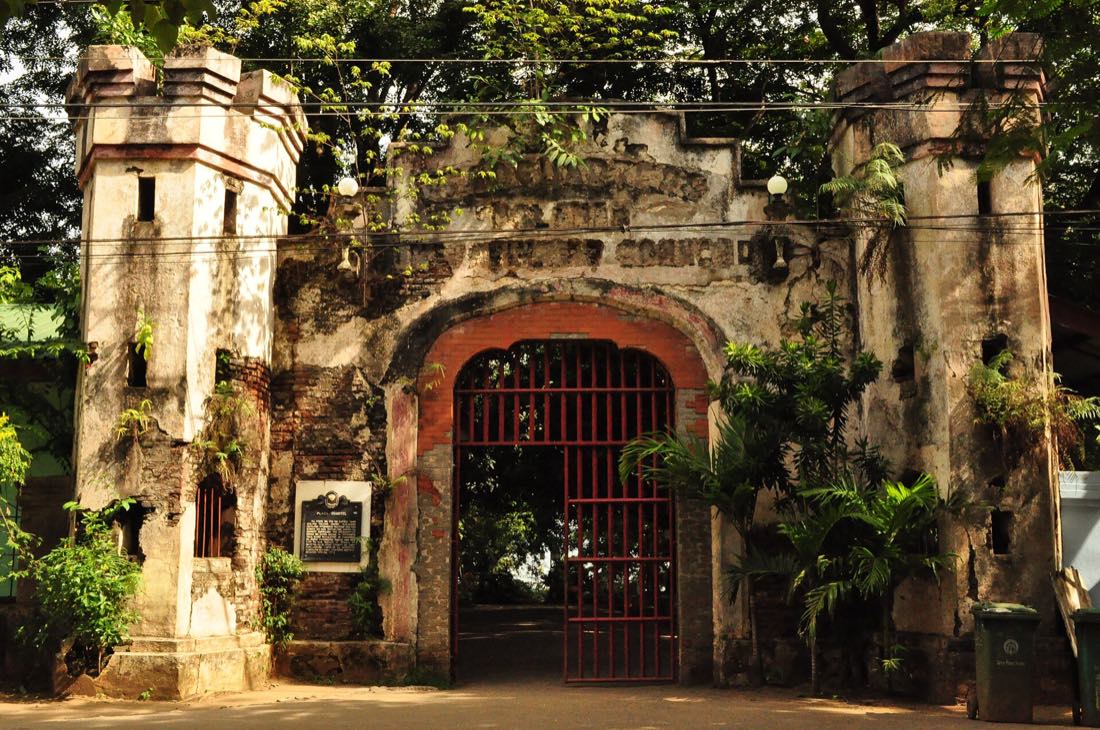
Plaza Cuartel and the Palawan Massacre
Go, and read this page before you do. On 14 December 1944, Japanese guards at POW Camp 10-A — the ground you will be standing on — forced about 150 American prisoners of war into trench air-raid shelters, poured petrol into the entrances and set them alight. 139 men died. Eleven escaped. Today it is a quiet garden plaza in Brgy. Liwanag with the preserved cuartel gate, the shelter remains and memorial markers, next door to the pale-blue Immaculate Conception Cathedral. Entry is free to about ₱20, it takes 20 to 30 minutes, and sunset is the hour to be here.
14 December 1944
This is told plainly because it deserves to be told plainly, and because most visitors arrive knowing nothing about it.
By December 1944 American forces were advancing through the Philippines, and Japanese command had issued a policy of killing prisoners rather than allowing them to be liberated. At POW Camp 10-A in Puerto Princesa — this site — around 150 American prisoners were being held. On the afternoon of 14 December 1944, following an air-raid alarm, the guards forced the men into the trench air-raid shelters they had dug themselves, then doused the entrances with petrol and set them on fire. Men who broke out were shot and bayoneted.
One hundred and thirty-nine men were killed. Eleven survived. Some got over the bluff at the edge of the camp, down to the shore and into Puerto Princesa Bay, and swam. Filipino guerrillas and scouts under Nazario Mayor sheltered them, and they were eventually evacuated by PBY Catalina flying boat. That is not a footnote — without Filipino civilians taking that risk, there would have been no survivors at all.
Two of the eleven anchor the story. Glenn McDole, whose account became the book Last Man Out, and Eugene Nielsen, whose debriefing in January 1945 reached American planners.
Why this site is in a Hollywood film
What happened here changed what the American command believed about the fate of every other prisoner in the Philippines, and it changed it within six weeks.
Nielsen's January 1945 testimony convinced planners that Japanese forces would murder prisoners rather than surrender them. That conclusion directly spurred the raid on the Cabanatuan camp on 30 January 1945 — the Great Raid — and shaped the liberations of Santo Tomas and Los Baños that followed. The 2005 film The Great Raid opens with the Palawan Massacre for exactly that reason.
Afterwards, 16 men were tried; several were convicted with sentences from two years to life, and all had been amnestied by the end of 1958. General Yamashita's command-responsibility conviction cited Palawan among the atrocities it rested on.
The escape route itself is not visitable. The stretch of coast the survivors came ashore on sits inside today's maximum-security Iwahig zone and is off limits, which a February 2024 visitor confirmed the hard way.
A garden, a gate and three memorials
Manage the expectation: this is a small, calm, restored plaza rather than a museum. It takes twenty minutes and it is the twenty minutes that stay with you.
You will find the preserved gate and walls of the old Spanish cuartel the plaza is named for, the remains of the shelters and tunnel, memorial markers listing the dead, and a Palawan Survivors memorial — the US War Memorials registry records three separate monuments on the site. It is shaded, waterfront-adjacent and one block from the port. There is no interpretive centre and no audio guide, which is precisely why arriving cold leaves people underwhelmed. It holds 3.6/5 from 284 TripAdvisor reviews, and that number is essentially a measure of how many people turned up without the story.
Next door is the Immaculate Conception Cathedral. The present structure dates from 1961, twin-spired and neo-Gothic, and it is famously pale blue inside and out. It stands on the site of the city's first mass in 1872, the parish feast is 8 December, entry is free and it is open around daylight mass times. Fifteen minutes covers it, and the two together are one stop rather than two.
Sunset is the hour. The plaza faces the bay, the light is good, the heat has gone, and the Baywalk is a ten-minute walk away for dinner from about 18:00. That is the single best free evening in this city and it starts here.
Where to spend history time
Puerto Princesa has four places that hold historical material and they are not equally worth your afternoon. If you only do one, do the first.
| Where | Entry | Time | What you get | Verdict |
|---|---|---|---|---|
| Plaza Cuartel Brgy. Liwanag, west end of the grid | free–₱20 unverified | 20–30 min | The massacre ground, the cuartel gate, the shelter remains and three memorials. Free, open, waterfront-adjacent | WORTH IT |
| Immaculate Conception Cathedral literally next door | free | 15 min | 1961, twin-spired neo-Gothic, pale blue inside and out. Feast day 8 December. Open around daylight mass times | WORTH IT |
| Palawan Heritage Center Capitol complex | ₱50 an older ₱150 figure circulates | 30–45 min | Touch screens, holograms and dioramas on Palawan's indigenous cultures, with good local guides. Open Mon–Thu 09:30–16:00 and closed Fri to Sun | DEPENDS |
| Palawan Museum Mendoza Park, Valencia Street | unverified | 30 min | Ethnographic, wartime and Tabon Cave material in the American-era city hall. Operating status and 2026 hours are unverified and reviewers describe it as tired | SKIP |
| Iwahig Prison and Penal Farm 30–45 min south | free | 30–45 min | The 1904 open-air colony. Related to this page only in that the survivors' escape coast is inside its maximum-security zone, which is off limits | DEPENDS |
Plaza Cuartel's fee and hours are both unverified for 2026 — sources report free entry and a token fee of around ₱5–20 collected by caretakers, with hours running roughly 08:00 to 17:00. Read the review record on TripAdvisor, and the cathedral's here.
The practical bit
Go on your own, not on the van
This is the one stop on the city-tour loop that is genuinely better done independently, because the thing you need is time to read the markers.
A shared tricycle from anywhere on the tourist strip is ₱12–25 and it is walkable from the cathedral end of Rizal Avenue. That is the whole logistics problem. On the half-day city tour you get 20 minutes here between a drive to Baker's Hill and a drive to the crocodile farm, with a guide whose quality is a lottery — some tell the story properly and some point at the gate and move on.
If you want the history told rather than read, the alternative is a heritage walking tour that stays in this quarter. If you want it read, print or save this page and give yourself half an hour. American visitors in particular come to Puerto Princesa specifically for this ground, and it rewards being unhurried.
Grab does not operate in Puerto Princesa. Not reduced, not patchy — absent. Guides that tell you to just grab a Grab from the airport were written from a desk. Ride-hailing firms have been reported as eyeing the city and none had filed for a franchise at the last check, so treat any app that does show cars as a bonus. The system here is the tricycle: ₱15–25 a hop shared, ₱100–150 to charter the whole thing from the airport into town. Agree the fare before you get in and you will never have a problem.
Booking the history rather than the loop
There is no ticket to buy for Plaza Cuartel. What you can buy is somebody to tell you what happened while you stand on it — and the standard ₱600–900 city tour gives it 20 minutes.
Plaza Cuartel questions, answered
What was the Palawan Massacre?
On 14 December 1944 at POW Camp 10-A in Puerto Princesa, Japanese guards acting on a kill-all policy forced around 150 American prisoners of war into trench air-raid shelters, poured petrol into the entrances and set them alight. 139 men died and 11 escaped, several by swimming Puerto Princesa Bay.
Is Plaza Cuartel worth visiting?
Yes, for 20 to 30 minutes, and only if you know the history first. It rates 3.6/5 from 284 TripAdvisor reviews, which is largely a measure of visitors who arrived cold — there is no interpretive centre, so the ground reads as an ordinary small park unless you know what happened on it.
How much does Plaza Cuartel cost?
Free, or a token fee of around ₱5–20 collected by caretakers depending on who is at the gate. Neither figure is confirmed for 2026 and no official price is published. Hours run roughly 08:00 to 17:00, also unverified — treat mid-afternoon as the safe window.
How many survived the Palawan Massacre?
Eleven of about 150 men. Some climbed the bluff at the edge of the camp, reached the shore and swam Puerto Princesa Bay, then were sheltered by Filipino guerrillas and scouts under Nazario Mayor before being evacuated by PBY Catalina.
What is the connection to The Great Raid?
Survivor Eugene Nielsen's debriefing in January 1945 convinced American planners that Japanese forces would kill prisoners rather than surrender them, which directly spurred the Cabanatuan raid of 30 January 1945. The 2005 film The Great Raid opens with the Palawan Massacre for that reason.
Can you visit where the survivors escaped?
No. That stretch of coast is inside today's maximum-security zone at Iwahig Prison and is off limits — a February 2024 visitor confirmed it. You can visit Iwahig's minimum-security area, which is a 30 to 45 minute drive south, but not the escape ground.
Is the Immaculate Conception Cathedral worth seeing?
Yes, and it is 15 minutes and free. The present twin-spired neo-Gothic structure dates from 1961 and is famously pale blue inside and out; it stands on the site of the city's first mass in 1872 and its feast day is 8 December. It is directly next door to Plaza Cuartel.
When is the best time to visit Plaza Cuartel?
Late afternoon into sunset. The plaza faces the bay, the heat has broken by about 16:30, and the Baywalk food stalls are a 10-minute walk away and firing up from around 18:00 — grilled squid ₱100–200, barbecue sticks ₱15.