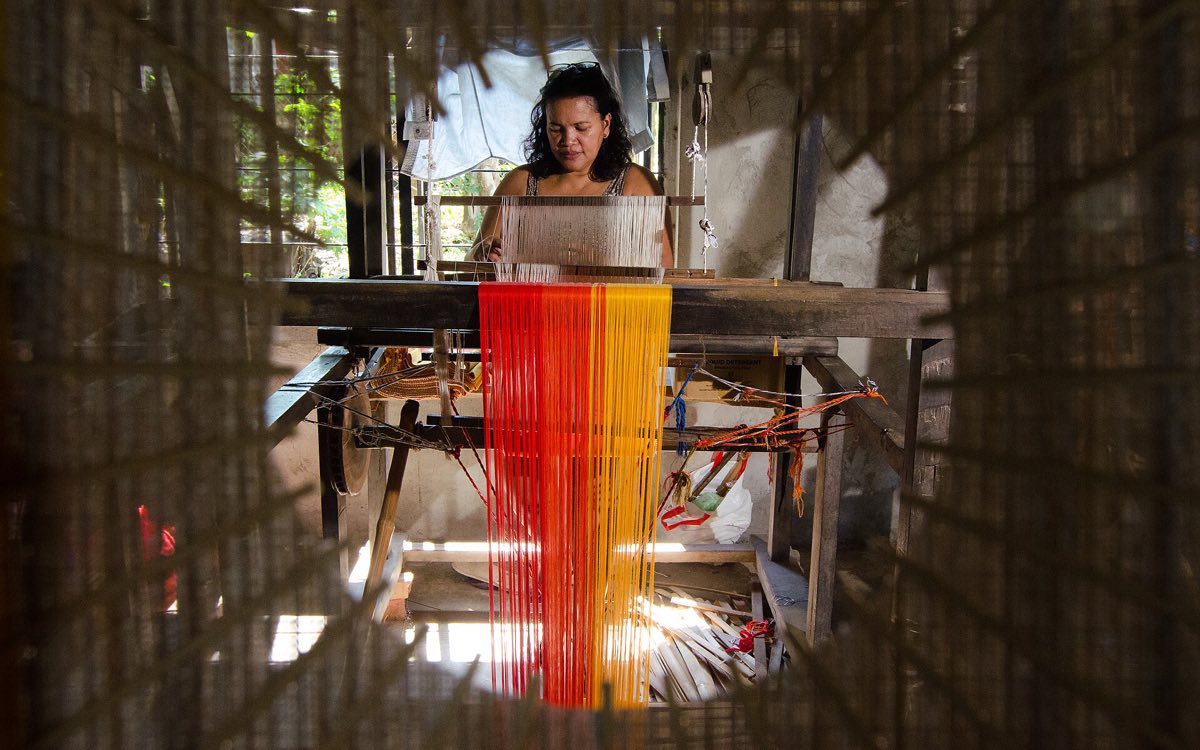
Binuatan Creations: the one real souvenir stop
The most genuinely local half hour on the city tour, and the only stop reviewers consistently call surprisingly good. Binuatan is a working hand-loom workshop in Employees Village, Sta. Monica, weaving native grass and plant fibre into bags, placemats, blinds and wall art. You watch the weavers, you can try the loom yourself — it is harder than it looks — and the showroom sells what was made on the premises. Entry is free or a token fee, the exact figure is unverified, and it takes 30 to 45 minutes. Reviewers call the goods a bit pricey, which is what made-on-site costs.
A workshop that lets tourists in, not a shop with a loom in the window
The distinction matters, because almost every souvenir counter in Palawan sells imported goods with a Palawan label on them.
Binuatan is a working weaving operation in Employees Village, Sta. Monica. The looms are in use when you arrive; the women at them are working, not demonstrating. The raw material is native grass and plant fibre grown and processed locally, and the output is bags, placemats, table runners, window blinds and wall art in the natural fibre colours plus dyed accents.
The visitor part is small and well-judged: you walk the workshop floor, watch the shuttle work, and are offered a go on a loom set up for the purpose. It is harder than it looks — the rhythm of beat, shuttle, beat is the whole skill, and thirty seconds of failing at it is the moment most visitors remember from their entire city tour. Then the showroom.
It takes 30 to 45 minutes. It is on almost every city tour itinerary, and economically it is a shopping stop — your operator is not hiding that and neither is this page. The difference from every other shopping stop in Southeast Asia is that the thing you are buying was made twenty feet from where you are standing.
The anti-fake-souvenir stop
Ask where to buy something real in Puerto Princesa and this is the answer, for reasons that survive scrutiny.
Provenance. You watched it being made. That is a claim almost nothing else on sale in this province can support — the shell work, the wooden carvings and the printed textiles in the market stalls come from Cebu, Manila and further, and nobody pretends otherwise if you ask directly.
Where the money goes. Wages to the weavers, materials bought locally. Reviewers describe the showroom as a bit pricey, and it is, relative to a market stall selling factory goods. Made-on-site by paid weavers costs more than imported. That is not a mark-up, it is the price.
It travels. Placemats, runners and folded bags pack flat and weigh nothing, which is more than can be said for the alternatives. The food answer is hopia from Baker's Hill at ₱50–120 a pack, and between the two of them you have solved the whole pasalubong problem in one afternoon on the same tour loop.
The wider point is on the Butterfly Eco-Garden page: buy crafts at community and maker-run counters, ask before photographing anyone, and never buy anything made from wildlife anywhere in Palawan.
Where to buy what, in this city
Four places sell things worth carrying home, and they do not overlap. Prices are what visitors report rather than a published list.
| Where | What | Roughly | Verdict |
|---|---|---|---|
| Binuatan Creations Employees Village, Sta. Monica | Hand-woven bags, placemats, runners, blinds and wall art in native fibre, made on site | premium over market stalls | WORTH IT |
| Baker's Hill Santa Monica ridge | Hopia and crinkles — the consensus best pasalubong in the city, and it packs flat | ₱50–120 a pack | WORTH IT |
| The public market, San Jose where the city shops | Dried mangoes, cashews, lato and everything edible, at half what the airport charges | cheap | WORTH IT |
| Robinsons Place and SM City air-conditioned, central | Pharmacies, phone credit, a cinema and a refuge from the 11:00 to 15:00 heat. Souvenirs are generic | mall prices | DEPENDS |
| Airport departure stalls after security | The same dried fruit and nuts at roughly double, bought in a hurry | double | SKIP |
| Anything made from wildlife anywhere in the province | Palawan is the country's trafficking frontier and its endemic pangolin is hunted at an estimated 26,800 a year. Never, from anyone | — | SKIP |
Binuatan's review record is on TripAdvisor. The entrance fee is free or token and unverified — historically free, with a browse of the showroom expected.
The practical bit
Take the tour, or charter a tricycle
Sta. Monica is not walkable from the tourist strip and no public route goes past the door.
Grab does not operate in Puerto Princesa. Not reduced, not patchy — absent. Guides that tell you to just grab a Grab from the airport were written from a desk. Ride-hailing firms have been reported as eyeing the city and none had filed for a franchise at the last check, so treat any app that does show cars as a bonus. The system here is the tricycle: ₱15–25 a hop shared, ₱100–150 to charter the whole thing from the airport into town. Agree the fare before you get in and you will never have a problem.
On the half-day city tour at ₱600–900 this is one of the three stops that earn the fare, alongside the crocodile farm and Plaza Cuartel. Independently, a half-day tricycle charter is ₱600–1,200 and lets you combine Binuatan with Baker's Hill and Mitra's Ranch on the same ridge, which is a reasonable two hours if you want to shop rather than sightsee.
Bring cash and bring more than you planned to spend. The single most common regret people report about this stop is buying one placemat.
The tours that stop here
There is nothing to book at Binuatan itself. What you book is the loop that includes it — local operators run it at ₱600–900 for 3 to 4 hours.
Binuatan questions, answered
Is Binuatan Creations worth visiting?
Yes, for 30 to 45 minutes. It is the only stop on the ₱600–900 city tour that reviewers consistently call surprisingly good, and the only place in Puerto Princesa where you can watch the thing you are buying being made and then try making it yourself.
How much does Binuatan Creations cost to enter?
Free or a token amount — historically free, with a browse of the showroom expected in return. No 2026 figure is published, so carry a couple of hundred pesos in case. The money is meant to be spent in the showroom, not at the door.
Can you try the weaving?
Yes. There is a loom set up for visitors and the staff will show you the beat-and-shuttle rhythm. Thirty seconds is enough to establish that it is considerably harder than it looks, which is most people's favourite moment of the whole 3 to 4 hour city tour.
What do they sell at Binuatan?
Bags, placemats, table runners, window blinds and wall art, all hand-woven on site over the 30 to 45 minutes you are there from native grass and plant fibre. Reviewers describe the prices as a bit pricey relative to market stalls, which is the difference between made here by paid weavers and imported.
Where is Binuatan Creations?
Employees Village, Brgy. Sta. Monica, on the northern side of the city near Baker's Hill and Mitra's Ranch. There is no public transport past it, so it is either the city tour or a ₱600–1,200 half-day tricycle charter.
What is the best souvenir from Puerto Princesa?
Hand-woven work from Binuatan if you want an object, and hopia from Baker's Hill at ₱50–120 a pack if you want food. Both are on the same city tour loop. Buy dried mangoes and cashews at the San Jose public market rather than the airport, where the same packet costs roughly double.
Can I pay by card at Binuatan?
Assume not. Puerto Princesa runs on cash outside the malls and larger hotels, and foreign card withdrawals cost about ₱250 each with per-transaction limits of ₱10,000–20,000. Draw money in the city before the tour picks you up.
Continue planning
Eat it with a local
Puerto Princesa food tours & tastings — guided street-food crawls and cooking classes with vetted operators, most with free cancellation.